

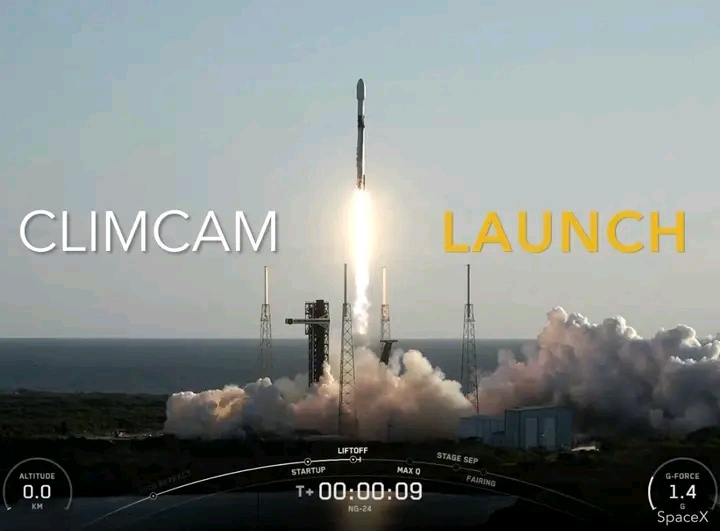
The Kenya Space Agency (KSA) has announced the successful launch of the Climate Camera (ClimCam) Payload destined for the International Space Station (ISS).
In a statement issued on Saturday, April 11, 2026, KSA said the ClimCam is among several payloads and other supplies to the ISS aboard the Northrop Grumman’s Cygnus XL commercial resupply mission (NG–24).
Where was ClimCam launched from?
The liftoff aboard SpaceX Falcon 9 rocket took place from Cape Canaveral Space Force Station in Florida on Saturday 11 April 2026 at 1.41pm East African Time.
“Cygnus XL NG–24 Spacecraft successfully separated from the Falcon 9 Rocket first stage booster after about 7 minutes from liftoff and is now expected to rendezvous with the ISS in the morning hours on Monday 13 April 2026, when the NG–24 will dock onto the ISS for the resupply mission,” read part of the statement.
The ClimCam is among many technological and scientific payloads that will be hosted on the ISS for experimental and technological showcases and applications.
It is a product of collaborative effort between the Kenya Space Agency (KSA), the Egyptian Space Agency (EgSA), and the Uganda National Space Programme.
Its development journey entailed multiple phases of design, assembly, integration, testing, and validation.
Key milestones included successful Assembly, Integration, and Testing (AIT) at EgSA facilities in Cairo, followed by comprehensive end-to-end testing and fit-checks at Airbus facilities in Houston, Texas.
The launch and eventual hosting on the ISS marks a significant milestone in international cooperation in harnessing space technologies.
What is the purpose of ClimCam?
Equipped with AI-powered capabilities, ClimCam is designed to deliver near real-time weather and climate data.
“This innovation will support natural resources management, environmental monitoring, disaster management and climate resilience initiatives across Eastern Africa and strengthen data-driven decision making for timely interventions,” Kenya Space Agency said.
The consortium constituting the Kenya Space Agency, the Egyptian Space Agency and Uganda National Space Programme emerged successful winners of a competitive Announcement of Opportunity (AO) issued by the United Nations Office for Outer Space Affairs (UNOOSA), in partnership with Airbus Defence and Space, as part of the Access to Space for All initiative, requiring consortiums to develop a payload that would be flown on the Airbus platform in the ISS.
Beyond its scientific and technological impact, ClimCam exemplifies African collaboration in the space sector.
The mission integrates expertise in space systems engineering, Earth observation, artificial intelligence, and data analytics, showcasing the continent’s growing capacity to develop transformative space technologies.
This successful launch marks a major step forward in strengthening Africa’s presence in the global space ecosystem and reaffirms Kenya’s commitment to leveraging space technology for sustainable development, environmental stewardship, and regional cooperation.
What does Kenya Space Agency do?
The Kenya Space Agency (KSA) is a State Corporation established with the mandate to promote, coordinate, and regulate space-related activities in the country.
The Agency seeks to nurture the growth of Kenya’s domestic space sector, focusing on the following:
- Enhancing the utilization of space services, technologies and space-derived data across the public sector for decision support, planning and predictive analytics.
- Developing national space capability.
- Promoting and nurturing the growth of the domestic space economy through support to startups in the space ecosystem.
- Awareness creation and sensitization on the utility of exploration and exploitation of space capabilities in national socioeconomic development.