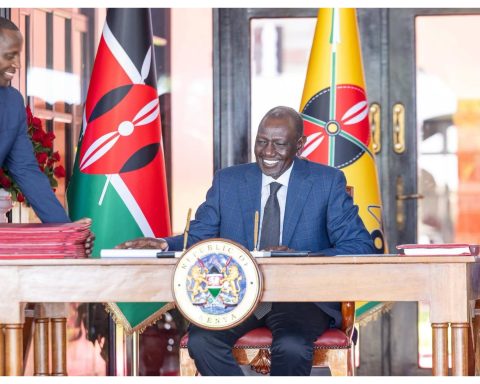


President William Ruto and His Highness Sheikh Mohamed bin Zayed Al Nahyan, President of the United Arab Emirates, have presided over the signing of the Kenya-United Arab Emirates Comprehensive Economic Partnership Agreement (CEPA), marking a historic milestone in the economic relations between the two nations.
The CEPA is the first agreement signed by the UAE with a mainland African country, representing a transformative step in enhancing trade, investment, and economic cooperation. The agreement strengthens Kenya’s position as a gateway to East and Southern Africa. It reaffirms the UAE’s role as a global logistics and financial hub connecting the Middle East, Asia, and beyond.
What’s the volume of trade between Kenya and UAE?
Trade between Kenya and the UAE has doubled over the past decade. In 2023, total trade between the two countries reached Ksh 445 billion, with the UAE ranking as Kenya’s sixth-largest export destination and second-largest source of imports, accounting for 16% of Kenya’s total imports.
Kenya’s key exports to the UAE include agricultural products such as meat and meat products, with Kenya exporting Ksh. 9.9 billion worth of these products to the UAE in 2023, representing more than half of the country’s total meat exports (Ksh. 18.3 billion).
Other notable exports include fruits—primarily pineapples, avocados, and mangoes—which account for Ksh. 5.2 billion. Additionally, vegetables and flowers, which support millions of livelihoods across the country, generated a further Ksh. 5.6 billion. In return, the UAE supplies Kenya with critical goods, including petroleum, machinery, chemicals, and other essential products.
Inside Kenya-United Arab Emirates Comprehensive Economic Partnership Agreement
The agreement aims to deepen trade ties by eliminating barriers to trade, simplifying customs procedures, and promoting industrialization and regional value chains.
The CEPA goes beyond trade in goods by addressing services, technological innovation, digital trade, and sustainability. It opens new opportunities for Kenyan service providers in sectors such as education, transport, communications, construction, and engineering to access the UAE market.
The partnership aligns with Kenya’s Bottom-Up Economic Transformation Agenda (BETA) by unlocking new markets for priority value chains, attracting foreign direct investment, and promoting technology transfer to support livelihoods across the country.
In addition, the CEPA reflects a shared commitment to sustainability and green economic growth. Both countries have agreed to promote clean technologies and environmentally responsible practices to ensure that economic progress is achieved sustainably.
This agreement builds on Kenya’s broader trade strategy, which includes key agreements such as the Kenya-EU Economic Partnership Agreement, the Kenya-UK Economic Partnership Agreement, the African Continental Free Trade Area (AfCFTA), and the African Growth and Opportunity Act (AGOA) with the United States. Today, Kenya has become Africa’s gateway to the world, with duty-free, quota-free access to global markets representing nearly half of the world’s GDP.
The signing of the Kenya-UAE CEPA is expected to unlock new opportunities, enhance bilateral relations, and contribute to the economic transformation of both nations. It sends a clear signal to global markets of Kenya’s readiness to expand its role as a global trade partner by offering premium products and services while embracing innovation and sustainable development.
Further, the CEPA provide the UAE with investment opportunities in several sectors of the Kenyan economy, including energy, water, agriculture, health, ports, airports, logistics, human resource development, and ICT. This aligns with the Kenyan government’s policy of reducing borrowing while enhancing investment capital, foreign direct investment (FDI), and public-private partnerships (PPPs).re