
By Michael Mundia Kamau
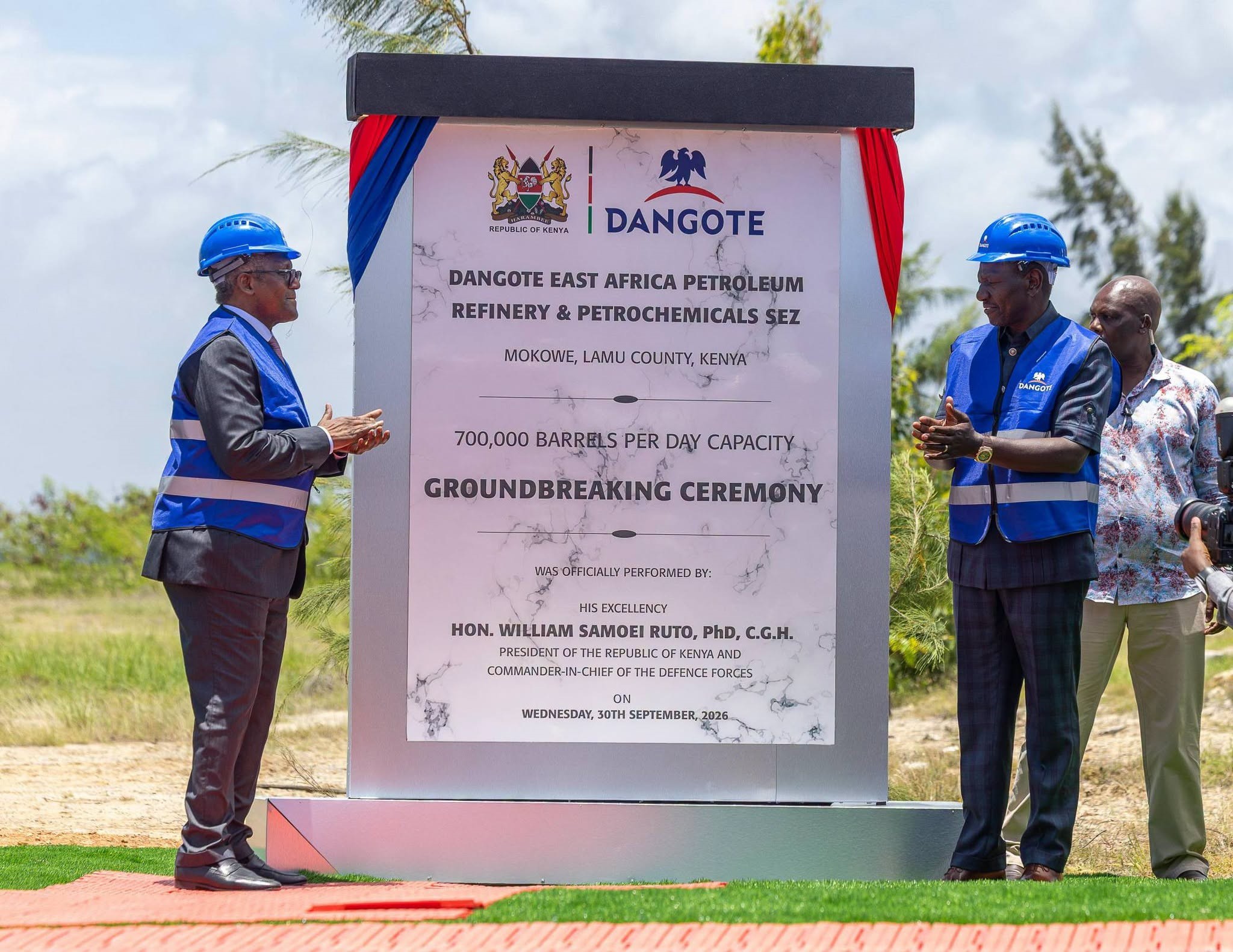
The groundbreaking ceremony for the proposed Dangote East Africa Refinery was held in Lamu, Kenya, on September 30, 2026. Yet despite the project’s estimated cost of KSh 2 trillion (approximately US$15.5 billion), key questions remain unanswered. No detailed prospectus was made public beforehand explaining how the project would be financed, who would underwrite it, or who would guarantee such a massive investment.
History provides reason for caution. In 1989, KANU and Britain’s Maxwell Communication Corporation proposed the Kenya Times Media Trust Complex at Nairobi’s Uhuru Park, an ambitious development that would have included twin 60-storey skyscrapers.
Parliament controversially agreed to guarantee the project despite its private nature. Legal disputes and financial constraints ultimately led to its collapse, leaving Uhuru Park fenced off for years before the proposal was abandoned in 1992.
Another example is Madhupaper Kenya Limited, founded by S.K. Macharia. In 1982, the company secured a KSh1 billion World Bank loan, then valued at about US$39 million, to expand its operations. Even adjusted for inflation, that borrowing is insignificant compared to the KSh2 trillion required for the proposed refinery. The obvious questions therefore remain: How will the refinery be financed, and who exactly are its shareholders?
Who owns Dangote East Africa Refinery?
The name “East Africa” raises additional concerns. Does it imply ownership by member states of the East African Community? If so, the region’s history suggests the need for full transparency. Following the collapse of the first East African Community in 1977, many of its key institutions evolved into Kenyan assets, including Kenya Airways, Kenya Power, Kenya Railways, the Kenya Ports Authority, and the former Kenya Posts and Telecommunications Corporation, which later gave rise to Safaricom. Uganda and Tanzania have long viewed the distribution of those assets as disproportionately favourable to Kenya.
A project of this magnitude should not leave room for assumptions. If East African states are indeed shareholders, what happens if the current regional bloc were to face the same fate as its predecessor? These questions should have been addressed before the groundbreaking ceremony.
Further scrutiny is warranted because the refinery’s launch closely coincides with the proposed Nairobi Securities Exchange offering of Global Depositary Receipts linked to the Dangote Petroleum Refinery in Lagos. The public has received little explanation of how these instruments work or what relationship, if any, they have to the East African refinery project.
The share offer, priced at KSh49 per share with a minimum purchase of ten shares, may appear attractive. However, it is difficult to ignore the timing. The offering creates the impression that funds are being sought for a project whose financing structure has not been clearly explained. Unlike the highly successful KENGEN Initial Public Offering of 2006, which attracted investors because Kenyans knew and trusted the company, Dangote remains largely unfamiliar to many local investors.
If Kenya genuinely believes refining capacity is a strategic investment, there is also the option of reviving and modernising the Kenya Petroleum Refineries Limited facility in Mombasa, which refined crude oil for five decades before ceasing operations in 2013. Supporters of the Dangote project must clearly explain what advantages it offers that cannot be achieved through existing infrastructure.
Global experience also suggests caution. The United States, despite more than a century of oil-refining expertise, has closed several refineries over the years and continues to face energy market challenges, including periodic spikes in fuel prices. Oil refining is therefore far from a guaranteed path to economic success.
Why scepticism about Dangote East Africa Refinery is justified
Kenyans also have painful memories of ambitious ventures and public fundraising campaigns that failed to deliver. From the 1993 effort to save Kenneth Matiba’s business empire from auction, to the 1996 campaign to revive the Kisumu Molasses Factory, concerns were raised over accountability and the ultimate use of funds. Many citizens also lost savings through failed banks in the 1980s and 1990s and collapsed pyramid schemes in the 2000s.
For these reasons, scepticism about the proposed Dangote East Africa Refinery is neither irrational nor hostile to investment. It is simply a demand for transparency. Before the public is asked to invest financially or politically in a KSh2 trillion project, clear answers must be provided regarding ownership, financing, guarantees, risks, and accountability. Until then, the refinery raises more questions than answers.