
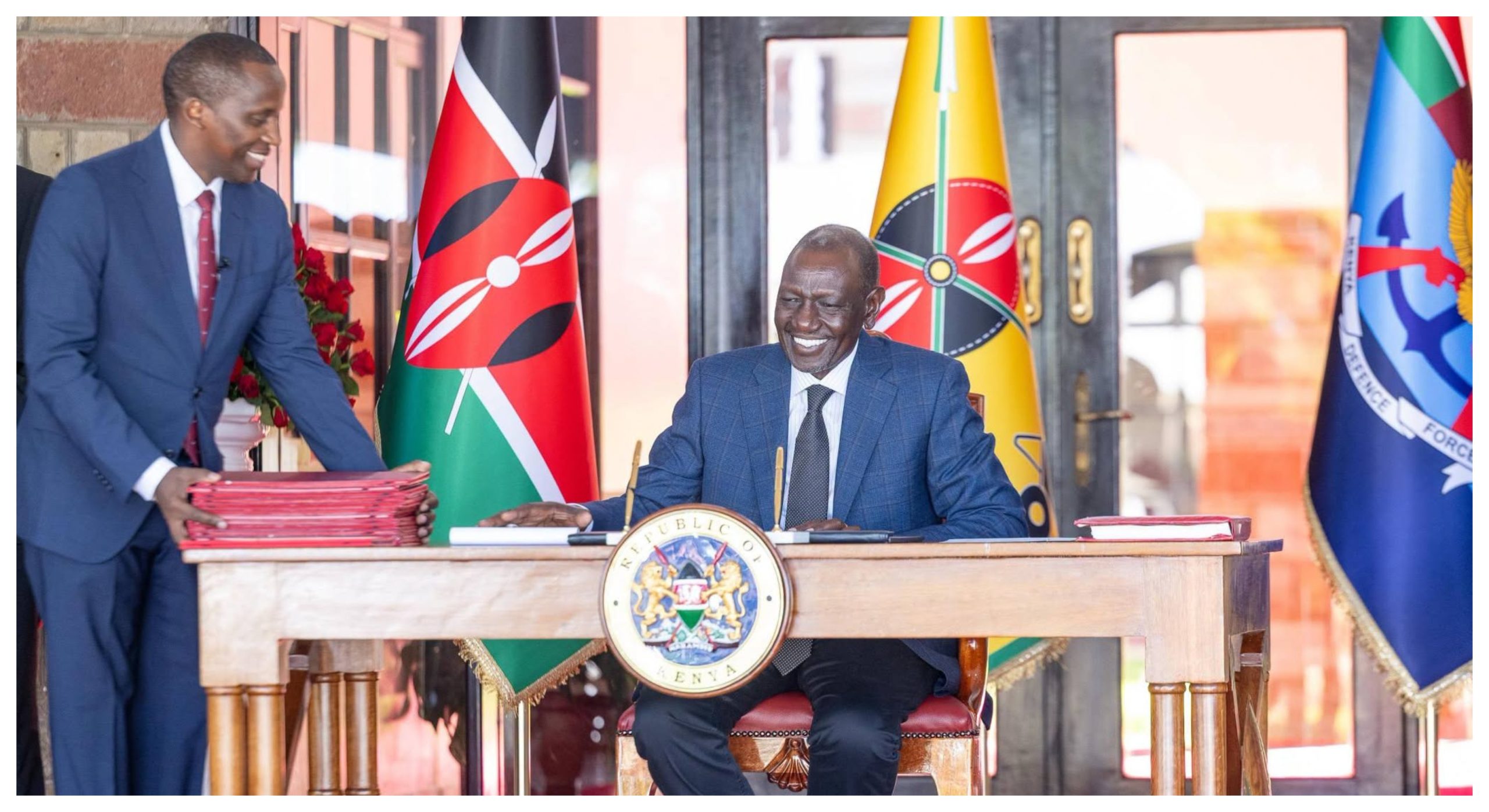
President William Ruto had assented to the Tax Laws (Amendment) Bill, 2026, and the Kenya Revenue Authority (Amendment) Bill, 2026.
The two Bills, sponsored by Leader of the Majority Party Kimani Ichung’wah, seek to address economic pressures affecting households and businesses while improving the efficiency of revenue administration.
The Tax Laws (Amendment) Bill, 2026, passed by the House on October 14, 2026, seeks to extend the reduction of Value Added Tax (VAT) on petroleum products from 16 per cent to eight per cent for a further 90 days, with provision for an additional 90-day extension by the Cabinet Secretary for the National Treasury, if necessary.
Importance of Tax Laws (Amendment) Bill
This measure follows the expiry on October 14 of the previous relief period, introduced in April 2026, amid continuing uncertainty in global oil prices linked to the crisis in the Middle East. The extension is intended to enable the Energy and Petroleum Regulatory Authority to sustain current fuel prices and avert a sharp increase that could raise transport costs and the prices of essential goods and services.

For households, businesses and transport operators, maintaining the reduced VAT rate is expected to ease cost pressures across the economy.
The Bill also targets construction costs through amendments to the Excise Duty Act. It changes the basis for calculating excise duty on tiles from weight to size, recognising that tiles are commonly sold per square metre.
Additionally, it proposes to reduce excise duty on sanitary ware from KSh50 to KSh30 per kilogramme and corrects the description of imported float glass and other specified glass products to allow qualifying imports from East African Community partner states without excise duty.
These measures are expected to lower construction costs for both public and private sector projects, including Affordable Housing programmes, while supporting investment and employment in the construction industry.
Details of the Kenya Revenue Authority Bill
Meanwhile, the Kenya Revenue Authority (Amendment) Bill, 2026, passed with amendments on October 7, seeks to improve the Authority’s operational efficiency and strengthen revenue collection.
The Bill provides for substantive membership of the KRA Board, excluding ex officio members, and includes the Managing Director of the Kenya Ports Authority to improve coordination between the two institutions, whose operations are interdependent.

It also provides for KRA funding of not less than two per cent of the revenue estimated for collection in each financial year, alongside an incentive equivalent to three per cent of revenue collected above quarterly targets.
The reforms are intended to enhance revenue collection through improved institutional capacity and efficiency, supporting the Government’s ability to finance public services without necessarily resorting to higher taxes.