

Moi Teaching and Referral Hospital has introduced stricter visitor rules as part of enhanced Ebola prevention measures, amid an active outbreak of the Bundibugyo strain in neighboring Democratic Republic of Congo and Uganda.
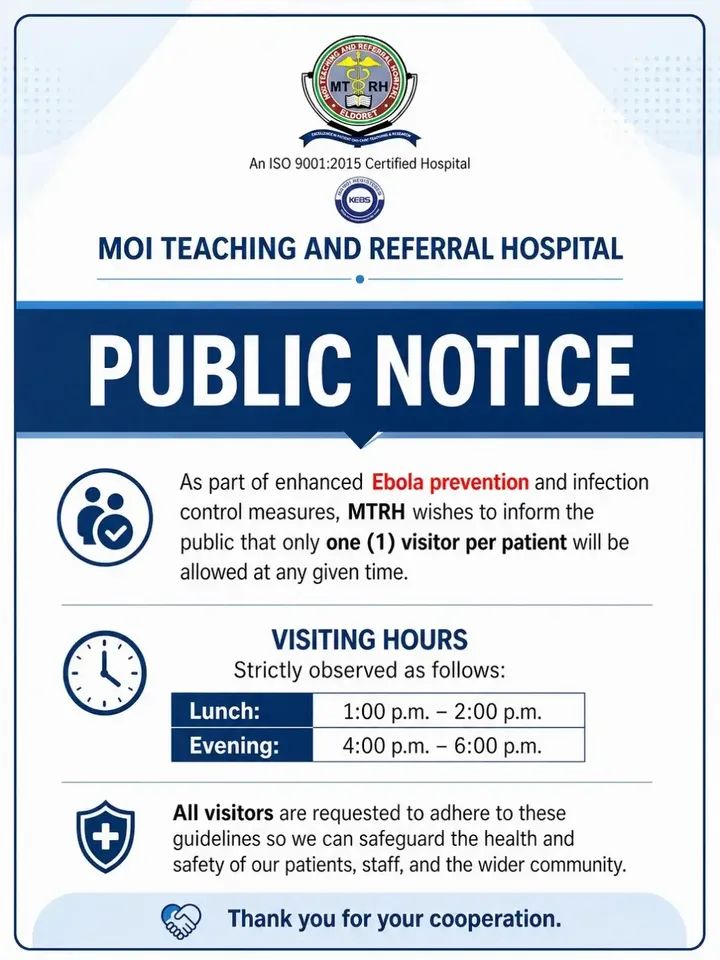
In a public notice seen by Uasin Gishu News on June 18, 2026, the ISO 9001:2015 certified hospital said only one visitor per patient will be allowed at any given time.
Visiting hours have also been set to 1:00 p.m. – 2:00 p.m. for lunch and 4:00 p.m. – 6:00 p.m. in the evening, and will be “strictly observed”.
“All visitors are requested to adhere to these guidelines so we can safeguard the health and safety of our patients, staff, and the wider community,” MTRH stated.
Ebola context: Regional outbreak, Kenya on alert
Kenya has not recorded any confirmed Ebola cases as of June 19, 2026. However, the country is on high alert after the DRC declared an outbreak of the rare Bundibugyo strain on May 15, 2026, which has since killed 241 people out of 906 suspected cases.
The outbreak has spread to Uganda, which has reported 16 cases.
Uasin Gishu, where MTRH is located, is listed among 12 “very high-risk counties” for Ebola due to travel and trade links.
Meanwhile, the Ministry of Health said more than 80,000 travelers have been screened at Kenya’s points of entry, with 56 suspected samples all testing negative.

MTRH’s role in Kenya’s Ebola response
MTRH is one of the designated isolation and treatment facilities in Kenya’s Ebola preparedness plan.
Health Cabinet Secretary Aden Duale confirmed that specialized Ebola units have been established at Kenyatta National Hospital, Kenya National Police Hospital, and Moi Teaching and Referral Hospital.
The hospital’s new visitor limits align with national infection control measures. The Ministry of Health has also set up four laboratories for Ebola testing, enhanced screening at borders, and activated rapid response teams 24/7.

A planned 50-bed US-backed quarantine facility at Laikipia Air Base is also part of the broader response to handle exposed travelers, though MTRH’s unit will serve Kenyan patients.
MTRH urged the public to rely on official Ministry of Health channels for accurate information and to observe hand hygiene and other preventive measures.