



You might soon find Ugali flour made from grass on the shelves of your favourite supermarkets and nearby shops.
This is after four Kabaraka University students had a major breakthrough in the research they have been doing since 2020. The research involved finding out if there was a possibility of making flour out of grass – which would then be used to cook ugali – Kenya’s staple food.
Faith Wandia, a Kabarak University Master’s Degree Student in Business Administration (Finance option) is the brain behind this innovative idea.
The 24-year-old says it has taken her, and three other students two years to finally have a breakthrough.
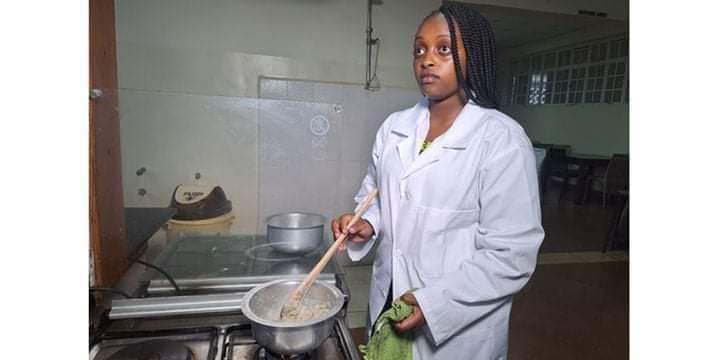
“We were trying to see what will work and in the process, we ended up using a lot of resources. Also, shipping costs were too high,” Wandia said during an interview with NTV.
Her research work involved students studying different courses at the Nakuru-based university. They were Innocent Bahati (Clinical Medicine), Salome Njeri (Economics) and Edgar Ruto (Computer Science).
“We had to convert cellulose from one chemical form to another to make it safe for human consumption,” said the Clinical Medicine student.
“Human beings cannot consume grass because they cannot break down cellulose in grass. So we had to convert the grass into starch,” he added.
But why did the students pick grass, and not any other crop? According to the brainchild behind the innovation, they settled on grass because it grows on between 50 to 60 per cent of the world’s surface area.
Process of converting grass to ugali flour
It is a long process for the grass to be worked on before it finally comes out as ugali flour. First, the grass is harvested, washed to remove contamination, dried and crushed into powder.
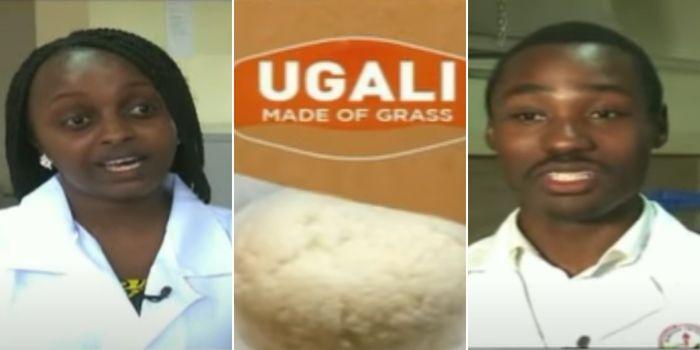
“Then we add water and enzymes to the mix, and cellulose is converted to amylose – almost similar to the starch found in maize,” explains Bahati.
The end product has a texture and smell similar to that of the ugali flour from maize.
Wandia notes that the motivation behind her innovation was the high number of people that die annually due to hunger. She hopes it will help address it.
“When I started this project, I had goals and I’m excited that with this product, we’re going to save so many lives,” said the 24-year-old university student.
When the innovation will be approved and commercialized, production for a kilogram of grass ugali flour will be at an estimated cost of Ksh23.
The final product will retail at Ksh35 – over half cheaper that the current cost of ugali maize flour which averages between Ksh70 and Ksh120.

But the innovation will have to be scrutinized by relevant government agencies, incusing the Kenya Bureau of Standards (KeBS) to ascertain its safety before it gets a green light to be commercialised.
Meanwhile, Kabarak University has already started the process to patent the innovation.
“We have already started the intellectual property registration process with Kenya Industrial Property Institute to patent the innovation,” said Wilson Balongo, the Kabarak University Coordinator of Innovation.







Kenya has very inovative young generation
aai hii nayo siwezi kula bwana