

Kenya Electricity Generating Company PLC (KenGen) has reported revenue growth of 6.4% for the financial year ended June 30, 2026, supported by increased electricity sales and improved dispatch across its diversified generation portfolio as Kenya’s peak electricity demand reached an all-time high of 2,549MW.
Revenue rose by 6.4% to Ksh.59.7 billion from Ksh.56.1 billion in the previous financial year, while operating profit increased to Ksh.14.2 billion, up from Ksh.13.6 billion in 2025. The performance reflects KenGen’s continued operational resilience and its central role in meeting the country’s rising demand for electricity.
Profit after tax remained broadly stable at Ksh 10.35 billion, compared with Ksh 10.48 billion in 2025, a marginal shift of 1.2%. This was mainly attributable to a reduction in finance income, from Ksh 4.1 billion to Ksh 2.9 billion, following the strategic deployment of cash resources into capital investments intended to expand and strengthen Kenya’s electricity-generation infrastructure.
“KenGen’s performance demonstrates the strength of our diversified renewable-energy portfolio and the disciplined execution of our G2G Strategy,” said KenGen Managing Director and CEO, Eng. Peter Njenga. “More importantly, it reflects our ability to respond to Kenya’s growing electricity needs while investing for the future. Every additional megawatt of dependable, renewable power strengthens the economy, supporting homes, hospitals, schools, industries and the enterprises creating opportunities for millions of Kenyans.”
KenGen also strengthened its balance sheet during the year through prudent capital and debt management. Finance costs declined by 12.1% to Ksh 2.0 billion as continued repayments reduced outstanding loan balances. Total borrowings fell by Ksh.12.2 billion to Ksh.97.1 billion, enhancing the Company’s financial flexibility and capacity to fund future growth.
The results were achieved against the backdrop of a resilient domestic economy despite heightened geopolitical tensions and disruptions across global energy markets. Kenya’s gross domestic product expanded by 5.3%, compared with 4.9% in 2025, contributing to increased economic activity and higher electricity consumption.
Kenya’s electricity demand in 2026
National peak electricity demand rose to a record 2,549 MW, recorded on July 15, 2026. The increase highlights the expanding energy requirements of Kenya’s households, businesses and industries, as well as the need for timely investment in additional generation capacity.
“Record electricity demand is a powerful signal of a growing and increasingly connected economy,” Eng. Njenga said. “Our responsibility is to stay ahead of that growth by delivering reliable, sustainable and competitively generated electricity. By expanding renewable capacity and strengthening system resilience, we are helping protect consumers from the volatility associated with fossil-fuel generation while creating the energy foundation for Kenya’s industrial transformation.”
During the year, KenGen supplied 8,975 GWh of electricity to the national grid, representing 57.2% of Kenya’s total electricity supplied to the grid. More than 90% of the electricity dispatched by the Company came from renewable sources, reinforcing KenGen’s position as the country’s leading renewable-energy generator and a critical contributor to Kenya’s clean-energy transition.
Building on its FY2026 performance, KenGen is accelerating the development of new generation capacity in line with the Least Cost Power Development Plan. The Company is advancing a diversified pipeline spanning geothermal, hydro, solar, wind, nuclear energy and Battery Energy Storage Systems.
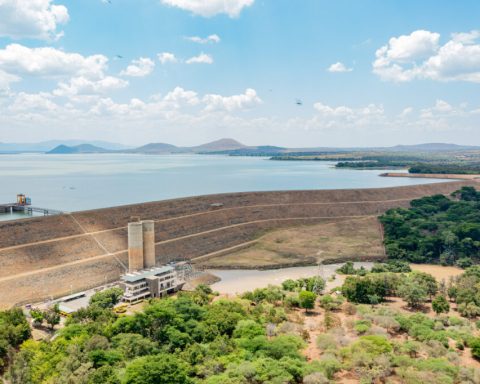
Priority initiatives include the 63 MW Olkaria I Geothermal Power Plant Redevelopment, the 42.5 MW Seven Forks Solar Project, the 8.6 MW Gogo Hydropower Plant Upgrade and the 58.42 MW Wellhead Leasing Geothermal Project. KenGen is also progressing battery-energy-storage solutions and the planned raising of Masinga Dam.
“These investments are designed around the needs of the Kenyan consumer,” Eng. Njenga added. “They will increase available generation capacity, improve flexibility during periods of peak demand and reinforce the resilience of the national grid. Our ambition to add approximately 5,540 MW of renewable energy by 2034 is ultimately about ensuring that electricity remains a dependable enabler of everyday life, enterprise and national prosperity.”
What are KenGen’s new revenue streams?
Beyond electricity generation, KenGen is leveraging its assets, technical expertise and innovation capabilities to develop new revenue streams and create wider economic value. The KenGen Green Energy Park, gazetted as both a Special Economic Zone and a Customs Controlled Area, offers investors access to renewable energy and a platform for green industrial development. The Park recently onboarded its fifth investor, marking further progress in its development as a hub for low-carbon manufacturing and sustainable enterprise.
KenGen is also expanding its geothermal consultancy and technical services in African and international markets, with engagements in Tanzania, Eswatini and Bhutan. These initiatives are expected to diversify revenues, strengthen financial resilience and position Kenyan expertise at the forefront of the global energy transition.
“As Kenya’s energy champion, our purpose extends beyond generating electricity,” Eng. Njenga said. “We are building the infrastructure, expertise and partnerships that will power a more competitive, climate-resilient and prosperous nation. Our focus remains clear: to create lasting value for consumers, shareholders and communities while powering Kenya’s next chapter of growth.”

 Get factual and reliable news as fast as they happen