


National Assembly Departmental Committee on Transport and Infrastructure chaired by Ndia MP George Kariuki has held consultative meetings with the Ministry of Roads and Transport led by Cabinet Secretary Davis Chirchir.
The meeting was for the MPs to get a status report of the implementation of the National Management Aviation Bill.
The Bill, sought to effect the recommendations of a Parliamentary report on the Inquiry into the proposed Kenya Airways privately-initiated investment proposal to Kenya Airports Authority that recommended among others; the nationalization of Kenya Airways.
This came after a downward trajectory that has seen KQ losing its market share and grip in the aviation sector to its competitors over the last couple of years.
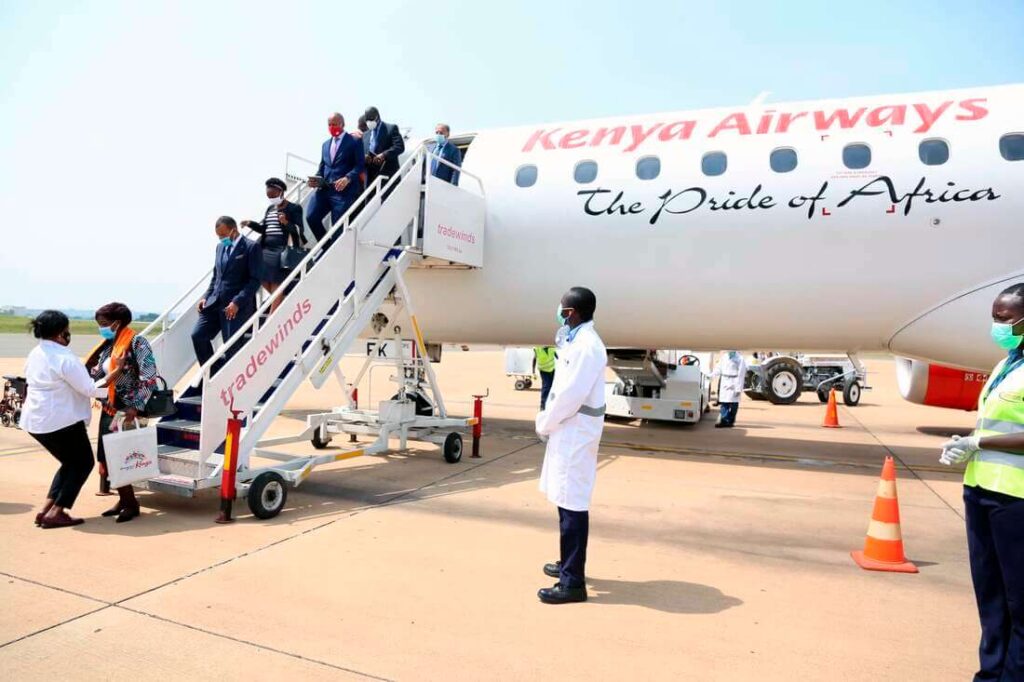
From 2015 to 2018 all competing carriers in the region increased their market share: Ethiopian Airlines by 20%, Qatar by 12%, and RwandAir by 22%, all while KQ experienced a loss 4%.
The lawmakers also questioned why KQ as a National carrier faces stiff competition from Ethiopian Airlines, RwandAir and currently our neighboring countries Tanzania and Uganda are reviving their Airlines.
Why KQ risks being crowded out of business
According to CS Chirchir, KQ’s competitors are focusing on both Infrastructural development and airline growth with Ethiopian Airlines’ construction of Absera Airport by 2029, with capacity to handle 100 million passengers and parking for 270 aircrafts.
RwandAir is planning to double its fleet to meet the growth demand and become the East African hub and negotiations are ongoing with Qatar Airways.
However, Kenya appears to have neglected its aviation sector both infrastructure and airline growth for over a decade and witnessed our competitors outgrow and become dominant players threatening our space as the preferred hub.

Vice chair Didmus Baraza has also called on the Ministry to licence private inspectors to address the capacity challenge of KCA that has been a thorn in the aviation sector as it delays certification , licensing and inspection of aircraft. He has also asked the CS to do a summary report highlighting the challenges in the aviation and how the policy is addressing it.
CS David Chirchir while addressing the committee, has assured members that the National Aviation policy seeks to create an enabling environment and set the foundation for the growth of the aviation sector that is a key enabler to the realisation of aspirations of vision 2030 that seeks to transform Kenya into newly industrializing middle-income country.
Kenya to get new passenger and cargo aircraft stands
The plan will also see the construction of new aircraft stands both passenger and cargo to alleviate apron congestion and a new partial parallel taxiways to allow for the closure of sections of the existing taxiways, which will be required for the construction of the new terminal. In addition the refurbishment to T1E and T2 to extend their service life until the new terminal becomes operational.
Chirchir also added that in the case of JKIA , a significant investment will be required and Government is open to private par
ticipation. A DBFOT concession ( Design, Build, Finance, Operate and Transfer) strikes a sensible balance between the obligation and risks that are transferred to the private sector and the ownership and strategic control retained by the Government.
The CS stating that such a model will see the private sector be responsible for the financing and execution of the development plan, and would bear a significant share of the project risk such as design, construction, demand and commercial responsibility.