

A National Assembly House Audit Committee has faulted the administration of Moi University over financial impropriety.
The impropriety, the committee noted, had hindered effective service delivery and grossly undermined the financial stability and reputation of the premier Institution.
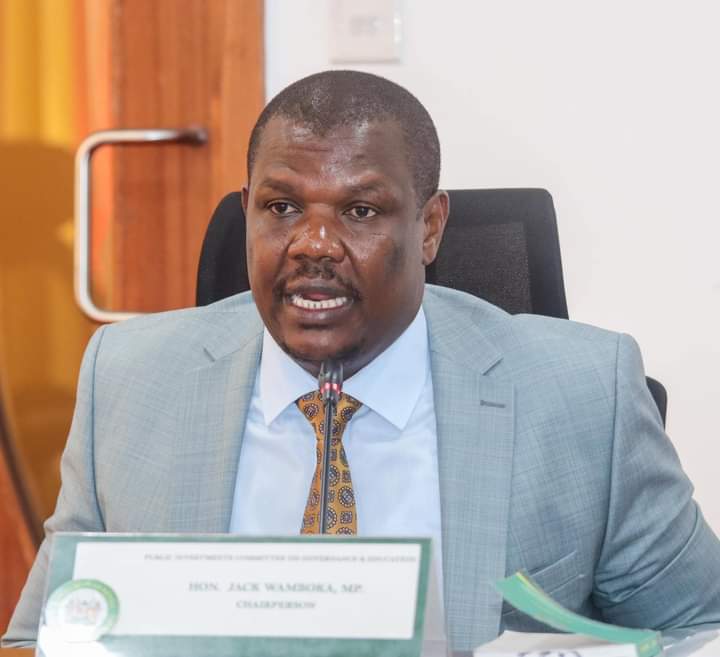
On Wednesday, September 18, 2024, the University’s administration led by the Vice-Chancellor Prof Isaac Kosgey, which was appearing before the Public Investments Committee on Education and Governance chaired by Jack Wamboka, was taken to task over fraudulent activities and irregularities attributed to a suspected collaboration between some unscrupulous staff at the institution and the Administration.

The cited incidences of fraud ranged from non-compliance with IPSAS 35 to irregular banking of students’ fees into the welfare account and fraudulent fees payment entries.
Others were in relation to the construction of the main gate, irregular engagement of casual employees beyond the stipulated time frame and delay in completion of the projects at the university.
Moi University’s acquisition of RIVATEX questioned
The Vice Chancellor (VC) Prof. Isaac Kosgey had a difficult time explaining Moi University’s investment in Rivatex East Africa Limited.
Financial reports before the Committee revealed that the institution had taken a Kshs. 3 billion loan and additional funding from the Ministry of industrialization, as part of government’s program to revive the textile company.
However, members questioned the University’s decision to buy-off a collapsing company, which in turn the Institution was unable to run and generate income from.
The lawmakers held the opinion that it would have been prudent to spend the borrowed money to improve the institution’s infrastructure and the living conditions of students instead.
The Committee Members further flagged another suspected case of fraud committed by the university’s employees as reported under cash and cash equivalent balance, excluding cheques payable to Moi University, Nairobi campus totalling to Kshs.7,727,190.
According to the records, the money had not been banked in the University’s Bank account but was instead irregularly banked in the Moi University Staff Welfare account.
Asked to explain this anomaly, Prof. Kosgey told the Committee that the amount had since been refunded by National Bank and the contracts of the staff involved, terminated.
However, the MP’s were not convinced by his explanation and inquired if the said officers were taken to court. They also also sought copies of the correspondence between the university and National Bank for verification.
“This report implies that Moi University and the educational system at large is characterized by fraud and corruption. The end result is, this breeds bad leaders, unqualified teachers, quack doctors, incapacitated managers and corrupt public officers,” an MP observed.
Tracking through the audit reports, the Committee also found fraudulent fees payment entries made by a staff member who had access rights and was entrusted with the duty of crediting fees payments to student ledgers in the system.
Further examination of records relating to sponsored fees paid through cheques, revealed that credit entries in the student ledgers totalling to Kshs.25,260,170 and debit entries totalling to Kshs.17,568,837 had been reversed.
In his defense, Prof Kosgey said that the University took disciplinary action against the member of staff who was involved, adding that the officer had since been dismissed from the service of Moi University and all the incorrect credit entries reversed from the affected students’ statements and cash books.
The lawmakers however noted that this was another case of a slap on the wrist, as the officer was never charged, creating further suspicions of the administration’s involvement.
How much did Moi University gate cost?
At the same time, the Committee delved into the scrutiny of the construction of the University main gate, a project which had cost the university Kshs.4,818,280. As per the contract agreement, the project was set to commence on 23 January, 2017 and take 16 weeks to complete.
However, physical verification of the project revealed that the project was incomplete and the contractor had abandoned the project after being paid the full contract sum.
Reports also revealed that the gate had been abandoned and a new gate had since been put up at a different location, resulting to wastage of government resources.
Another audit query unearthed by the Committee related to the engagement of casual employees and appointment of officers in acting capacity beyond the stipulated time frames as per the law. On this, Members found that the management was in breach of the law.
Further, a review of the report showed delay in completion of several projects as at the time of audit and that there were no approved extensions. The projects included the construction of Library Annex Campus and Builders Works at School of Dentistry.
The Committee Members further faulted the University for engaging in a loss-making commercial venture christened, Elimu Millers. According to the audit report, the University failed to penetrate the market due to high competition from other millers in the region, thus resulting to decreased sales and high operations costs.
Irked by these incidents, MP isWamboka pledged that the Committee would make far-reaching recommendations to bring those culpable to book.
“As a Committee, we shall bring sanity back to our universities and prevent the misappropriation and misuse of university resources through fraud, theft, embezzlement, among other financial malpractices by employees and management,” MP Wamboka stated.
With the Vice Chancellor unable to provide satisfactory responses, Hon. Wamboka moved to penalize him under the provisions of Standing Order 191(a).
Prof. Kosgey was given a period of two weeks to pay the fine to the Clerk of the National Assembly, before facing the Committee with all the relevant information, for further scrutiny.