

By Athletics Kenya
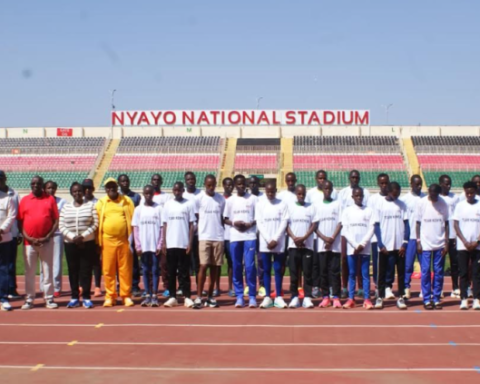
The seventh edition of the Kip Keino Classic is gathering momentum, with organisers working around the clock to prepare Nyayo National Stadium for the April 24 spectacle.
Meet director Barnaba Korir revealed that early renovations were a calculated effort to avoid the disruptions that derailed last year’s plans.
“Last year, we had issues with the stadium and were not able to host Kip Keino at Nyayo. But this year, everything is done. We now have a new tartan track, a Mondo surface installed last year, and we brought in a surveyor from World Athletics to ensure the stadium meets required standards,” Korir said.

Owen Malone, a Diamond League technical director for Shanghai, Brussels, and Xiamen meetings, confirmed the new track is on course for World Athletics certification within weeks.
“Everything is looking good. The first certification report will be sent to World Athletics next week, and it could be approved within two to three weeks,” Malone said.
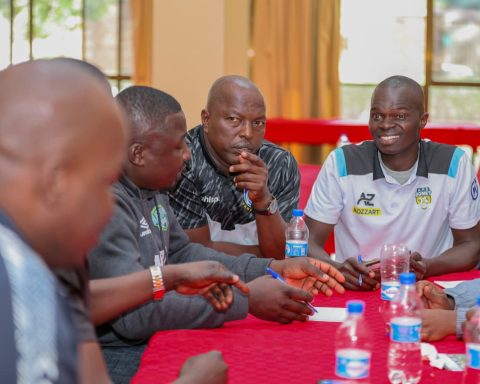
He praised the preparations, noting productive collaboration with Sports Kenya and Athletics Kenya.
“It has been a very fruitful three days working together in preparation for the event. We have been concentrating on competition equipment, timing systems, television production, and overall event presentation. Everything looks very good, and we are ahead of schedule compared to previous years,” he said.
Does the Mondo surface help in athletes’ performance?
With infrastructure in place, Malone believes the upgraded Mondo surface is primed to spark explosive performances.
“It is a Mondo track, which is very fast and popular with sprinters,” he said, pointing out Nairobi’s altitude of 1,700 to 1,800 metres as an added advantage.
“At altitude, there is less air resistance, which can help athletes achieve faster times.”
Unlike conventional tracks, the Mondo surface is firmer and engineered for superior energy return, crucial for speed.
“The sprinters understand this, which is why it is easy to attract top-level athletes. This track is hard and gives excellent energy return,” Malone noted.
“We can expect very fast times, especially in the sprints. The altitude can be a bit challenging for distance runners, but with Kenya’s depth of talent, we should still see quality races.”
Which new technology will be used at the 2026 Kip Keino Classic?
Meanwhile, the Kip Keino Classic is set to reach new heights this year with the introduction of WaveLight technology, promising faster times and a more immersive experience for fans.

WaveLight, a feature synonymous with elite Diamond League meetings, uses LED lights along the inside rail of the track to flash at pre-set speeds.
The system allows athletes to maintain a target pace, whether chasing world records or personal bests, while enhancing the spectacle for spectators.
Adding to the excitement, this year’s edition will run from 4 pm to 9 pm, marking a shift to an evening schedule designed to boost global visibility and provide a prime-time athletics experience.
Meet director Barnaba Korir confirmed that the WaveLight technology will be featured for the first time in Kenya.
“We want to try WaveLight this time because it helps produce fast times and gives athletes something to follow,” Korir said.
“If we are targeting specific times in an event, the system allows athletes to track the pace easily and hit those marks,” he added.
Korir added that a team of experts has already inspected the stadium to ensure the technology integrates seamlessly into the programme.
“We have already had a team here for inspections, and discussions are ongoing on how best to incorporate it into the programme,” he explained.
He also highlighted the benefits of the evening schedule, which mirrors the format of major international competitions.
“In most major events, including the Diamond League and other Continental Tour meetings, races are held in the evening. It is much better for television production and global viewership,” Korir said.