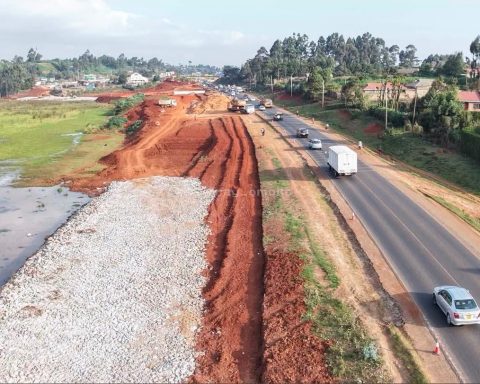


President William Ruto has presided over the official launch of the construction and dualization of the Rironi – Gilgil – Nakuru – Mau Summit (A8) Highway and the Rironi – Maai Mahiu – Naivasha (A8 South) Corridor.
The Rironi – Naivasha – Gilgil (A8) Highway covers 81 km, the Rironi – Maai Mahiu – Naivasha Road section is 58 km, and the Gilgil – Nakuru – Mau Summit (A8) Road, which is 94 km, forms part of a broader 233 km upgrade designed to ease mobility along one of Kenya’s busiest transport arteries.
“Under this transformative project, the Rironi-Naivasha section will be expanded into a dual four-lane carriageway, and the Naivasha-Gilgil section will be upgraded into a dual six-lane carriageway to accommodate heavier traffic,” State House said in a statement.
“The Rironi-Maai Mahiu-Naivasha highway will be transformed into a modern dual four-lane highway,” it added.
The construction of the 139km will be undertaken within two years at a cost of $863 million (KSh112 billion) by a consortium comprising the China Road and Bridge Corporation and the National Social Security Fund Board of Trustees.
It is implemented through a Public–Private Partnership (PPP) between China Roads and Bridge Corporation (CRBC) and the National Social Security Fund (NSSF) Consortium, and Shandong.

The project is scheduled for completion within two years.
Impact of dualing roads in Kenya
Beyond its economic significance, the upgrade will enhance access to essential services such as schools, hospitals, administrative offices, and emergency response facilities.
It also incorporates improved mobility and safety features, as well as modern drainage systems, including culverts and side drains, to prevent erosion, reduce flooding, and protect neighbouring farms and homes.
The corridor is expected to strengthen social integration and stimulate sustained regional development.

During the launch, President Ruto underscored the importance of innovative financing models in accelerating national development, describing the corridor as a gateway to prosperity and transformation.
The government also reaffirmed its commitment to delivering reliable, high-quality infrastructure that drives economic growth and uplifts communities.
The construction of the 139km will be undertaken within two years at a cost of $863 million (KSh112 billion).