
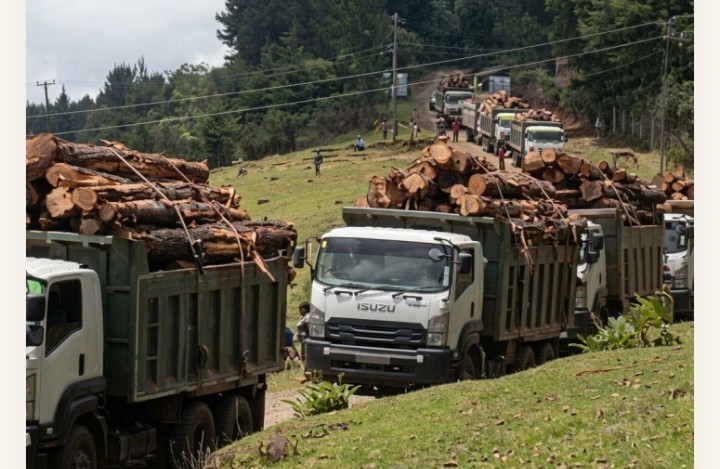
The Rift Valley, Central and Eastern Sawmillers Association has dismissed claims that ongoing harvesting in designated plantation areas amounts to deforestation, insisting it is conducting legal commercial forestry.
In a statement issued Saturday, October 10, 2026, from its Secretariat in Nairobi, the association said a deforestation narrative circulating around the work in gazetted plantations was misleading.
“We are not clearing natural forest, nor are we opening the forest estate to uncontrolled felling. Plantation trees are a crop. They are planted to be grown and harvested on rotation,” the association said in part of the statement.
The sawmillers said when plantation trees are left standing past maturity, they decay, lose commercial grade and cease generating royalties for the Exchequer.
They noted that harrvesting them now recovers revenue, clears the ground for the next rotation, and supplies timber to the local market before El Niño conditions close roads, raise rivers, and restrict access across large parts of the Rift Valley, Central, and Eastern regions.
“This is standard plantation management. It is not deforestation,” the association said.
Laws on harvesting mature trees in Kenya
Additionally, the sawmillers association stated that the sale and harvest of mature and over-mature plantation material is being done through open tender, in full compliance with the Public Procurement and Asset Disposal Act, 2015, the Public Procurement and Asset Disposal Regulations, 2020, the Forest Conservation and Management Act, 2016, and the Forests (Harvesting) Rules, 2009.
It said the timber supply chain supports substantial employment, with industry estimates placing sawmilling and wood processing, together with supporting services, at between tens of thousands and approximately 300,000 jobs.
According to the association, furniture and joinery account for roughly 125,000 to 160,000 livelihoods, the majority outside formal factories, while fuelwood and charcoal value chains sustain several hundred thousand producers and traders.
“Tea factories, schools, builders, and joinery workshops depend on this supply. When it is interrupted, mills idle and prices rise,” it added.
The sawmillers said harvesting does not end their responsibility, noting they replant in partnership with local Community Forest Associations (CFAs) and invite nurseries, schools, faith groups and residents to contribute seedlings or labour.
“Our commitment is clear: only the volumes authorised by tender, only plantation material that has reached maturity, and the land restored with the communities who live beside it,” the statement said.