
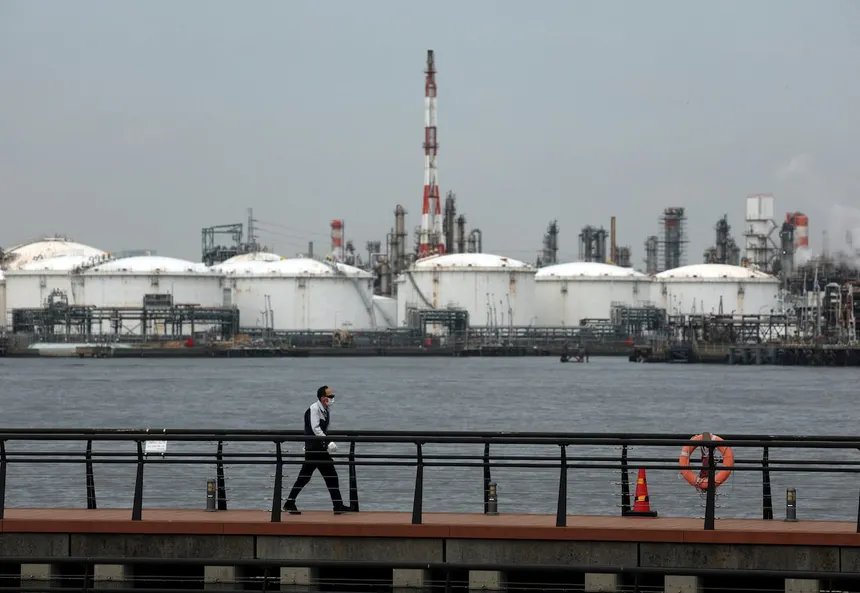
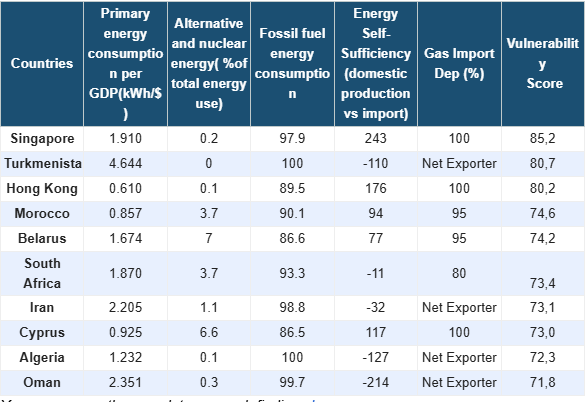
The March 2026 report on power supply risks has found that Singapore is the most vulnerable country if global energy markets collapse.
With oil prices up nearly 20% following the US-Israeli joint strikes on Iran, a new study by the Energy World Mag reveals which nations would struggle most if energy imports stopped suddenly.
The research examined 75 countries across seven different factors to determine which nations would struggle most during global energy disruptions.
This included measuring how evenly each country spreads its power generation across different fuel sources, rather than depending heavily on just one type.
The report also looked at energy self-sufficiency rates that show how much fuel countries import versus what they produce domestically.
Which countries are Vulnerable to a Global Energy Crisis?
Additionally, the study tracked natural gas import dependency specifically for wealthier nations.
Countries were assigned vulnerability scores from 0 to 100, with higher numbers indicating greater risk if energy supplies are disrupted.
- Singapore
- Fossil fuel dependency: 97.9%
- Energy self-sufficiency: Imports 243% more than domestic production
- Natural gas imports: 100%
- GDP per capita: $84,734
- Vulnerability score: 85.2
Singapore is the world’s most vulnerable country in the event of an energy market collapse. The city-state imports more than twice the energy it produces domestically.
Nearly 98% of that energy comes from fossil fuels, too, mostly shipped in from overseas. This means Singapore has almost no backup options if those supplies get disrupted.
The country also imports 100% of its natural gas, making it completely dependent on international markets where prices can spike overnight during shortages.
- Turkmenistan
Turkmenistan takes second place despite producing its own energy in massive quantities. The country gets 100% of its power from fossil fuels, with no solar, wind, or hydro alternatives. This single-source dependence can become a major problem if global fuel markets shift, even though Turkmenistan exports more energy than it uses.
The country’s $9K average income also limits how much money people have to cope with sudden price increases when energy costs climb.
-
Why is Hong Kong among the most vulnerable to future energy crises?
Hong Kong ranks third as one of the most import-dependent energy markets in the world. The city brings in 176% more energy than it produces, meaning it relies almost entirely on fuel shipped from other countries.
Like Singapore, Hong Kong gets nearly 90% of its electricity from fossil fuels and imports all of its natural gas. This leaves residents exposed whenever international suppliers face disruptions or decide to raise prices.
- Morocco
Morocco comes in fourth as North Africa’s most vulnerable country to energy shocks. About 90% of the nation’s power comes from fossil fuels, while domestic production covers only a small fraction of total needs.
Morocco imports 94% of its energy, making the country heavily dependent on foreign suppliers. Additionally, 95% of natural gas comes from abroad, and with average incomes around $4K, most Moroccans can’t easily afford sudden price jumps.
- Belarus
Belarus rounds out the top five, facing serious risks despite sitting next to major energy producers.
The country gets 87% of its electricity from fossil fuels and imports about 77% of its total energy needs. Natural gas dependency is even higher, with 95% coming from imports, mostly through Russian pipelines. This created major vulnerabilities during recent geopolitical tensions, and Belarus has limited financial resources to handle price shocks, given its $8K average income.
10 countries most vulnerable to future energy crises
“The 2022 European energy crisis taught us that even wealthy countries with diverse economies can face severe shortages when they depend too much on imported fuel. Germany and Italy had to ration energy despite being among the world’s largest economies,” said an energy market analyst from World Energy Mag.
“The difference is that places like Singapore or Hong Kong have even less room to manoeuvre because they produce almost no domestic energy. When supplies get disrupted, they can’t just switch to local coal or increase their own gas production,” the analyst added.