
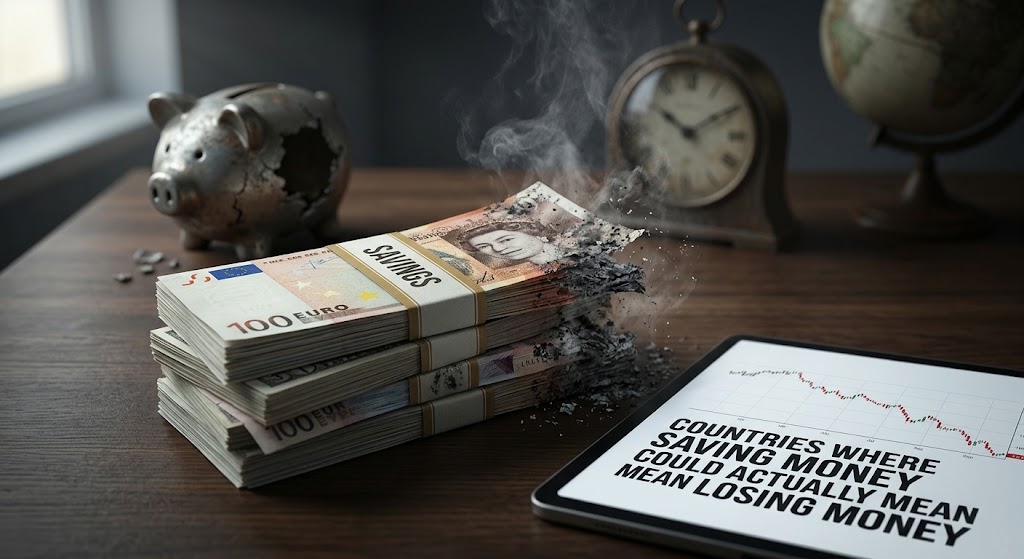
Holding cash instead of depositing or investing it is a losing strategy, especially in Greece and Spain, where it costs people thousands, according to an October 2026 study.
This freshly released report by British Business Funding reveals the top 10 countries where inflation has been eating through cash savings.
The research examined developed economies to find where holding cash costs people the most compared to a smarter alternative.
For each country, the study tracked how much inflation rose over five years and measured what 10,000 in local currency was actually worth after that period if kept entirely in cash. It then compared that against a split strategy: 5,000 placed in a bank deposit earning the average annual deposit rate, and 5,000 invested in the country’s main stock index with dividends reinvested.
By combining both halves, the report calculated the cost of holding cash over depositing and investing.
5 countries where keeping money in a savings account cost people the most
Here’s a look at the top 5 countries where keeping money in a savings account cost people the most:
- Greece
- 5-year inflation:16%
- Average deposit rate:2% annually
- 5-year stock return (ATHEX, dividends reinvested):5%
- Cost of playing it safe with a €10K deposit:€8,338
Greeks are losing thousands by keeping money in cash instead of depositing or investing it. Inflation rose 16% over five years, so €10,000 sitting at home shrank to just €8,621 in real purchasing power. The alternative looked very different: €5,000 in a bank deposit grew at 1.2% annually, while the other €5,000 put into the Greek stock market returned 23.5%, bringing that half to over €14,000. Together, that adds up to €8,300 that cash savers missed out on.
- Spain
Spain is another country where holding onto cash makes little financial sense. Inflation climbed 18% over five years, leaving €10,000 in cash worth just €8,475 in real terms. The Spanish stock market, tracked by the IBEX 35, returned 20.5% over the same period, turning a €5,000 investment into nearly €12,7000. The deposit half, earning 1.93% annually, could bring the smart-saving portfolio to €15,400, nearly €7,000 more than those who kept everything in cash.
- Italy
Italy ranks third with a similar financial situation to Spain. Prices here also climbed 18% over five years, cutting the real value of €10,000 down to €8,500. Meanwhile, Italian banks paid a 2.2% interest rate, even more than Greece. The local stock market, the FTSE MIB, also grew 19.1% over the period, and when both halves are added together, the smart-saving returns come to €14,900, leaving cash holders €6,400 worse off.
- Austria
Austria has one of the highest inflation rates in Europe, with prices rising 25% over the past five years. That left €10K in cash worth just €8,000 in real terms. The smart-saving approach worked out significantly better. Banks paid 2% annually on deposits, and the ATX stock index returned 17% over the same period. Together, those two halves could become €13,200 after inflation, putting smart savers €5,200 ahead of those who held cash.
- The UK
The UK is another country where keeping cash is a losing strategy. British savers had access to some of the better deposit rates compared to the rest of Europe at 4.2% annually, and the FTSE All-Share delivered 12.6% on the invested half over five years. Together, those two halves reached £12,200 in real terms. The cash alternative offered none of that, with 19.4% inflation cutting £10K down to just £8,000 a difference of £4,200.
10 countries where keeping money in a savings account cost people the most
| Country | Currency | Holding Cash: After 5 Years, 10,000 Ends up as | Smart Saving: After 5 Years, 10,000 Ends up as | Cost of Playing It Safe |
| Greece | EUR | 8,621 | 16,959 | 8,338 |
| Spain | EUR | 8,475 | 15,428 | 6,953 |
| Italy | EUR | 8,475 | 14,883 | 6,408 |
| Austria | EUR | 8,000 | 13,195 | 5,195 |
| United Kingdom | GBP | 8,065 | 12,252 | 4,187 |
| United States | USD | 8,130 | 12,390 | 4,260 |
| Canada | CAD | 8,475 | 13,121 | 4,646 |
| Portugal | EUR | 8,475 | 13,092 | 4,617 |
| Norway | NOK | 8,264 | 12,422 | 4,158 |
| Netherlands | EUR | 8,000 | 11,706 | 3,706 |
“Holding cash feels safe, but it isn’t. Every year prices go up, and the money sitting at home buys a little less than it did before. Splitting it between a deposit and the market is one of the simplest ways to fight that. Stocks grow money faster over time, but they drop too, and not everyone is comfortable with that risk.
ETFs are a popular middle ground. They spread money across hundreds of companies at once, so one bad stock doesn’t hurt the whole pot. Bonds are another option, offering a fixed return over a set period with less volatility than stocks. Everyone’s situation is different, though. None of this is financial advice, and it’s always worth doing your own research before moving money around,” a financial expert from British Business Funding shared more insights.
Author
-

 Uasin Gishu News is a leading local news platform dedicated to delivering breaking news, politics, business, development, sports and community stories from Uasin Gishu County. We are committed to informing, educating and connecting our audience through accurate, timely and impactful journalism that highlights the people, events and issues shaping the region. You can reach us by email at uasingishunews.co.ke@gmail.com or on WhatsApp/Call +254106468848.