
By Dr Philip Zeal Chebunet, PhD, CPM, Political Communication Expert
In politics, great leadership is not merely about winning an election. It is about understanding the changing needs of a nation, anticipating the future, and continuously adjusting the national conversation to serve a bigger vision.
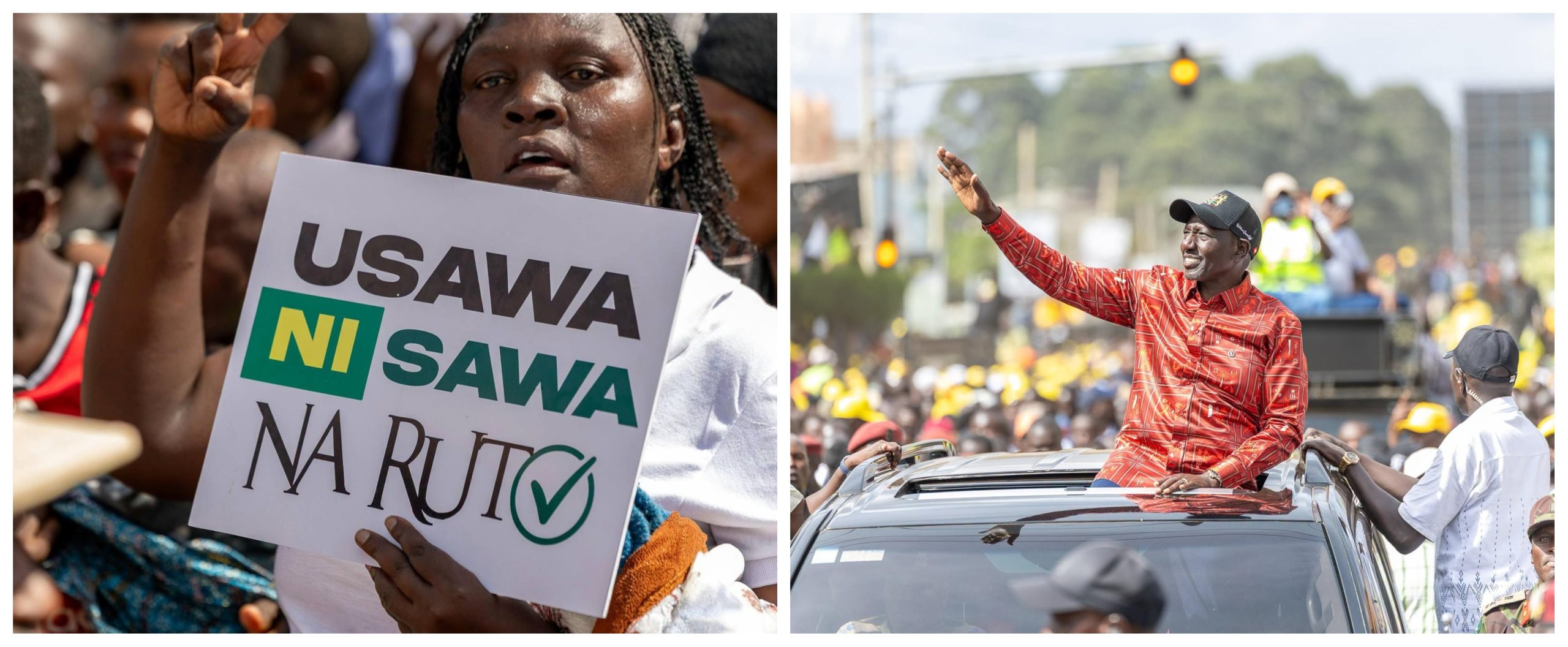
President William Ruto’s transition from “Kazi ni Kazi” to “Usawa ni Sawa – Mbele Pamoja” offers an interesting window into his political thinking and the evolution of his national agenda, and it is a transition worth examining beyond the ordinary interpretation of changing political slogans.
In 2022, Ruto introduced a powerful political and economic philosophy through the Hustler Narrative. It was a message that challenged traditional economic hierarchies and placed the ordinary Kenyan at the centre of the national development conversation. Kazi ni Kazi was not simply a campaign slogan. It communicated a philosophy of dignity in work, economic empowerment, enterprise development, and the belief that every Kenyan, regardless of social background, deserved an opportunity to prosper.
The wheelbarrow became a symbol of this philosophy. It represented the small trader, the boda boda operator, the Mama Mboga, the farmer, and the ordinary citizen whose economic contribution had often been overlooked. But a strategic leader understands that a country cannot remain at one stage of its development journey forever.

Why Ruto has transitioned to Usawa ni Sawa
The transition to Usawa ni Sawa can be understood as an expansion of the original economic empowerment agenda. If the Hustler Narrative was about creating opportunities for ordinary Kenyans to participate in the economy, Usawa ni Sawa introduces a broader question: how do we ensure that the benefits of national development reach every region, community, and citizen? This is a significant evolution.
Economic empowerment without equitable distribution risks leaving some communities behind. Similarly, national development must go beyond impressive projects in selected locations to ensure that every region has a meaningful stake in Kenya’s progress. The new narrative therefore brings equality, fairness, inclusion, and shared prosperity into the national conversation.
This is where the Equal Economic Transformation narrative becomes critical. Kazi ni Kazi gave Kenyans dignity. Usawa ni Sawa promises fairness. Equal Economic Transformation is the process that turns dignity and fairness into reality. It means equal opportunity, where every Kenyan, whether hustler, farmer, youth, woman, or person with disability, has a fair chance to access capital, markets, skills, and technology.
It means equal participation, where development is not designed for Kenyans but with Kenyans, and where counties, villages, and informal sector players become co-creators of growth rather than spectators. It means equal distribution, where growth is measured not only by GDP, but by how many households are lifted, how many counties are transformed, and how many young people are employed. And it means equal dignity, where no work is too small, no region is too remote, and no citizen is too ordinary to matter in the national story.
In other words, Equal Economic Transformation is the movement from empowering individuals to transforming systems, from helping the hustler survive to building an economy where the hustler can thrive, compete, and lead. It is the economic engine of Usawa ni Sawa.
What Ruto’s new Usawa ni Sawa Mbele Pamoja means
One of the interesting dimensions of Ruto’s political approach is his ability to reposition the national conversation around changing priorities. The 2022 message responded to the economic frustrations of ordinary Kenyans. The emerging message speaks to the broader question of how Kenya can build a more inclusive and balanced development model. This is the difference between merely running a political campaign and continually defining a national agenda.

A country of Kenya’s diversity requires more than economic growth. It requires balanced development, opportunities across regions, investment in infrastructure, stronger institutions, and a deliberate effort to address historical inequalities. The shift towards Usawa ni Sawa places these questions at the centre of the political conversation.
The most important interpretation of this transition is that the two slogans need not contradict each other. Kazi ni Kazi established the dignity of work and the importance of economic participation.
Usawa ni Sawa seeks to broaden that conversation towards fairness in the distribution of opportunities and national resources. One speaks to economic empowerment; the other speaks to equitable participation in national development. Both can be understood as complementary pillars of a wider development philosophy. The ambition should be to move from empowering individual hustlers to building an economy in which every Kenyan, wherever they live and whatever their background, has an opportunity to thrive. Equal Economic Transformation is that ambition made practical.
The addition of Mbele Pamoja gives the new narrative another important dimension. Kenya cannot achieve its development ambitions through regional competition, ethnic divisions, or the politics of exclusion. The country needs a common national purpose. The language of moving forward together speaks to the importance of national cohesion, political accommodation, and shared responsibility for the country’s future. It also recognises that national development is not the responsibility of one political formation or one community. It requires collective effort.
What will shape the 2027 political conversation?
As the country approaches another electoral cycle, the political conversation will inevitably turn to performance, accountability, and the future direction of Kenya. President Ruto’s challenge is to demonstrate how the economic empowerment agenda can translate into equitable development and improved livelihoods. The questions will be practical: Are more Kenyans finding employment? Are businesses expanding? Are farmers earning better incomes? Are counties receiving development investments? Are young people accessing opportunities? Are public services becoming more accessible? These are the measurements through which the new narrative will ultimately be judged. A slogan can communicate an ambition, but implementation must give it meaning.
Equal Economic Transformation will be judged by the same test: Is the economy becoming more equal in opportunity, more fair in distribution, and more transformative in outcome?

Perhaps the most important lesson from the transition is that national leadership requires an evolving vision. Kazi ni Kazi spoke to the economic dignity of the ordinary Kenyan. Usawa ni Sawa speaks to the aspiration for a country where development opportunities and national resources are shared more equitably.
The two messages can form part of one continuing national journey: from economic empowerment to shared prosperity, from individual opportunity to collective progress, and from the politics of economic struggle to the ambition of an inclusive nation. President Ruto is presenting a broader development conversation. The responsibility now is to translate that conversation into measurable national outcomes.
From Kazi ni Kazi to Usawa ni Sawa. From the Hustler to the Nation. From Economic Empowerment to Equal Economic Transformation. From Shared Prosperity to a United Nation. Mbele Pamoja. The mark of strategic leadership is not simply changing the message; it is ensuring that every new chapter advances the larger national vision.