
By Michael Mundia Kamau
Many Kenyans feel trapped. They are frustrated by the country’s direction and often unsure of whom to trust or where to turn for solutions.
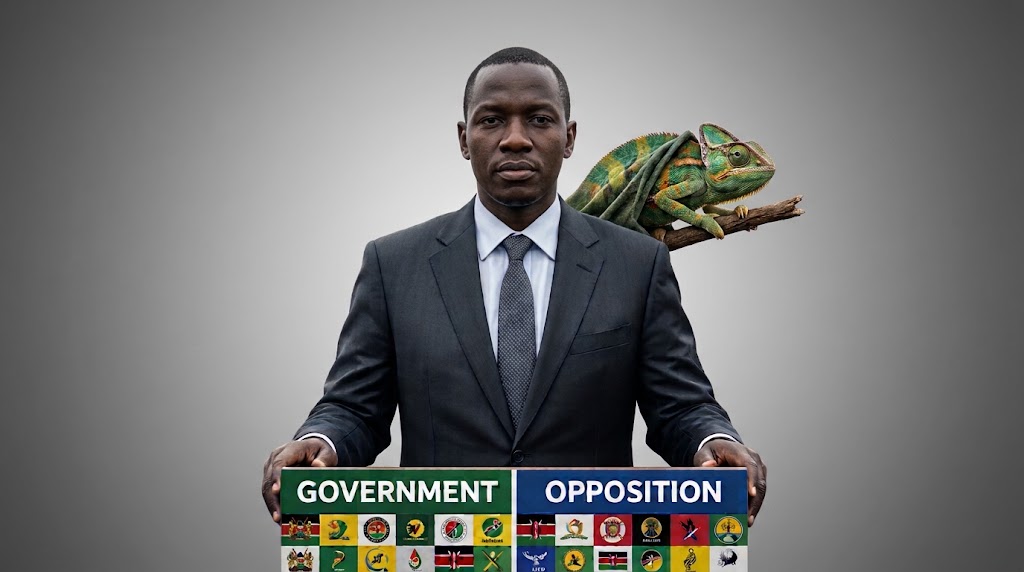
Perhaps most worrying is the growing lack of confidence in political leaders, whether they are in government or in the opposition. This distrust has been fueled, in part, by the ease with which many prominent politicians switch sides, moving between government and opposition over the years with little regard for ideological consistency.
Why Kenyan leaders are like chameleons
Consider the following examples:
- Uhuru Kenyatta and William Ruto were in opposition between 2003 and 2008. From 2013 to 2022, they served together as President and Deputy President, respectively.
- Moses Wetang’ula served in government from 2008 to 2013 before moving to the opposition, where he remained from 2013 to 2022. He returned to government in 2022 after being elected Speaker of the National Assembly.
- Kalonzo Musyoka was part of government from 1985 to 2013 and has remained in the opposition since then.
- Raila Odinga spent much of his political career moving between the opposition and government. He was in opposition from January 1993 until March 2002, when his National Development Party (NDP) merged with KANU. Following the merger, he became KANU Secretary-General and joined government as Minister for Energy. In September 2002, he left KANU and returned to the opposition as a co-founder of the Liberal Democratic Party (LDP).
The frequent formation and reorganisation of political parties is often driven by access to political influence, resources, and funding, which also explains the persistent infighting within many parties.
- Raila rejoined government in 2003, only to return to the opposition after the 2005 constitutional referendum. The Orange Democratic Movement (ODM) emerged from the “No” campaign following that referendum. He later returned to government as Prime Minister from 2008 to 2013 before rejoining the opposition, where he remained until he died in 2025.
- Musalia Mudavadi served in government from 1989 to 2003. He spent the period between 2003 and 2008 largely outside government before returning as Deputy Prime Minister in 2008. He remained in government until 2013, moved to the opposition from 2013 to 2022, and re-entered government in 2022 as Prime Cabinet Secretary. Notably, the position of Prime Cabinet Secretary is not explicitly provided for in Kenya’s Constitution.
In many ways, Kenya’s political leaders resemble chameleons. One moment they are in government; the next they are in opposition. This constant shifting of political alliances has contributed to public disillusionment with elections and governance. Many voters increasingly struggle to distinguish genuine ideological differences from political expediency.
The growing voter apathy reflects this frustration. An estimated eight million Kenyans did not participate in the 2022 General Election, a significant figure that points to widespread disengagement from the political process.
Kenyan politics is both predictable and unpredictable. While shifting alliances are expected, the outcomes of these realignments often remain uncertain. Today, there is considerable talk of a united opposition ahead of the 2027 General Election. Yet the situation on the ground suggests otherwise.
Is Kenyan opposition united?
With less than a year until the August 2027 elections, the opposition remains fragmented. ODM, for instance, appears to have one foot in government and another in the opposition. Senior ODM figures such as John Mbadi, Hassan Joho, Wycliffe Oparanya, and Opiyo Wandayi hold positions in government, while the party’s former Secretary-General, Edwin Sifuna, remains a prominent voice in the opposition-led Linda Mwananchi movement.
Beyond ODM, opposition figures including Kalonzo Musyoka, Fred Matiang’i, Justin Muturi, David Maraga, Eugene Wamalwa, Ndindi Nyoro, and Rigathi Gachagua have yet to demonstrate a common vision or speak with one voice. The opposition lacks a clear and unified agenda, yet such clarity is essential in politics, just as it is in any other endeavour.
Many Kenyans are dissatisfied with the current state of affairs, and a divided opposition only adds to their frustration. By now, opposition leaders should have convened a joint conference, outlined a shared agenda, established a roadmap for achieving their objectives, and begun rallying around a single presidential candidate. Unity is never easy to achieve, but the sooner a structured plan is put in place, the better.
At the same time, President William Ruto’s administration faces criticism for what many perceive as a lack of a clear and coherent agenda. Yet the opposition has not presented a compelling alternative. By October 2026, voters would reasonably expect opposition leaders to have articulated their policy priorities, implementation strategies, and timelines across key sectors such as agriculture, employment, healthcare, education, and housing.
Instead, much of the political discourse remains dominated by personal attacks and name-calling between the government and the opposition. What is largely missing is a detailed roadmap for addressing Kenya’s economic and social challenges.
Kenya’s first four presidents, Jomo Kenyatta, Daniel arap Moi, Mwai Kibaki, and Uhuru Kenyatta, all made promises that were never fully delivered. President William Ruto has faced similar accusations. However, the government’s shortcomings do not absolve the opposition of responsibility. A fragmented and disorganised opposition cannot effectively hold government accountable or inspire confidence among voters seeking meaningful change.
Ultimately, Kenyans deserve more than shifting political alliances and electoral calculations. They deserve leaders driven by ideas, principles, and solutions rather than by whichever side of the political divide offers the greatest advantage at a particular moment. Only then can public trust in politics and democratic institutions begin to be restored.